8 CV Mistakes That Keep Nigerian Graduates From Getting Interviews
Recruiters often spend seconds on each CV. Here are eight common mistakes and how to fix each one.
8 CV Mistakes That Keep Nigerian Graduates From Getting Interviews
Getting a university degree is an important achievement, but having a certificate does not automatically guarantee employment. Every year, thousands of Nigerian graduates apply for jobs across different industries, yet many struggle to secure interview invitations despite having the required academic qualifications.
While competition for available positions is a major challenge, the problem is not always a lack of opportunities or professional experience. In many cases, applicants unknowingly make mistakes in their Curriculum Vitae (CV) that reduce their chances of being considered by recruiters.
Recruiters often receive hundreds of applications for a single vacancy. As a result, they may spend only a short time reviewing each CV before deciding whether an applicant deserves further consideration. A poorly structured document, irrelevant information or avoidable grammatical errors can make a qualified candidate appear unsuitable.
Understanding how to prepare a professional CV is therefore an important step towards securing employment. Below are eight common CV mistakes that could be preventing Nigerian graduates from getting interview invitations and practical ways to correct them.
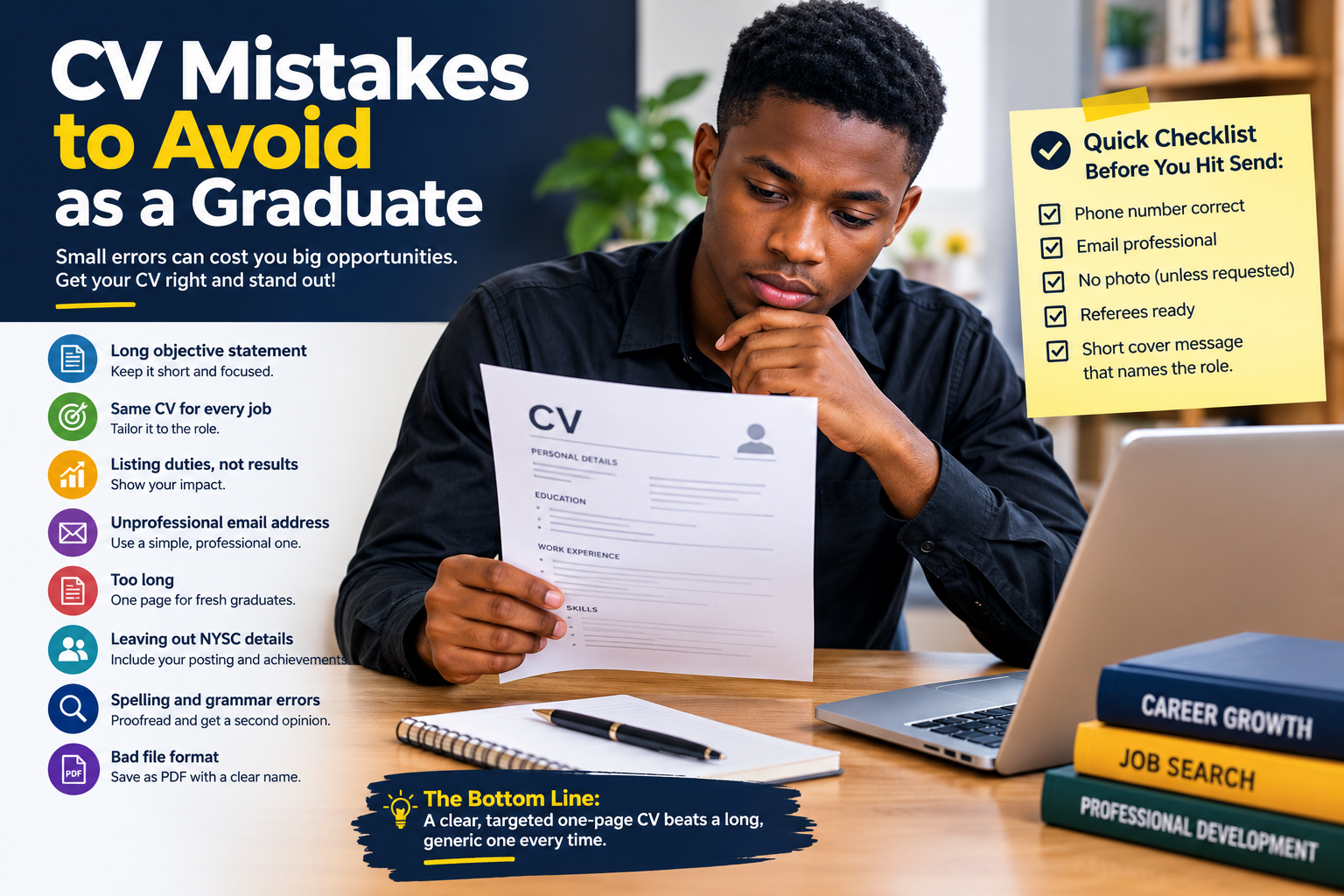
- Using the Same CV for Every Job Application
One of the most common mistakes among job seekers is submitting exactly the same CV for every vacancy, regardless of the position or organisation.
A graduate applying for an administrative position may have a different set of relevant skills from someone applying for a data analysis, customer service or marketing role. Using one general CV for all these positions makes it difficult for recruiters to identify the applicant's suitability.
Employers want to see how a candidate's qualifications, experience and skills relate to the specific responsibilities of the advertised position.
How to correct it: Read every job description carefully and adjust your CV to highlight the qualifications, experience and relevant skills required for that particular role. You do not need to create an entirely new document each time; simply make appropriate adjustments to your professional summary, skills and work experience.
- Writing an Unprofessional Personal Profile
Some graduates begin their CVs with lengthy personal statements that provide little information about their professional abilities.
Expressions such as "I am a hardworking, honest and dedicated individual looking for a challenging opportunity" are common, but they do not explain what the applicant can contribute to an organisation.
Recruiters are more interested in relevant qualifications, practical abilities, experience and career objectives than generic descriptions.
How to correct it: Write a short professional summary of approximately three to five lines. Explain your educational background, strongest relevant skills, professional interests and the value you can bring to the employer.
For example, instead of writing that you are simply hardworking, explain that you have experience in customer relations, Microsoft Office applications, administrative support or data management.
- Including Unnecessary Personal Information
Many Nigerian graduates still prepare CVs containing excessive personal details that are not relevant to the recruitment process.
Some include their religion, marital status, state of origin, date of birth, full residential address and other personal information without considering whether the employer actually requires them.
Although certain organisations may request specific details during recruitment, including too much personal information can make a CV unnecessarily lengthy and expose applicants to avoidable privacy risks.
How to correct it: Prioritise your full name, professional contact number, email address, general location and, where relevant, a LinkedIn profile or professional portfolio.
Only include additional personal information when the employer specifically requests it or when it is genuinely necessary for the position.
- Making Your CV Too Long or Poorly Structured
A CV containing too many pages does not necessarily demonstrate that an applicant is more qualified than other candidates.
Some graduates include every activity they have participated in since secondary school, unrelated responsibilities, lengthy explanations and information that adds little value to their applications.
Poor formatting can also make an otherwise impressive CV difficult to read. Inconsistent headings, different font styles, excessive colours and poorly arranged sections may discourage recruiters from examining the document carefully.
How to correct it: Keep your CV concise, organised and easy to navigate. For most recent graduates with limited professional experience, one or two pages are usually sufficient.
Use clear headings, consistent fonts, appropriate spacing and bullet points. Arrange information logically, beginning with your professional summary, education, relevant experience, skills and other useful qualifications.
- Listing Skills Without Providing Evidence
Another mistake is claiming to possess several professional skills without showing how those abilities have been developed or applied.
For instance, writing "good communication skills, leadership, teamwork, problem-solving and computer literacy" does not necessarily convince an employer that the applicant can perform effectively in a professional environment.
Recruiters want evidence that candidates understand the skills they claim to possess.
How to correct it: Support your skills with examples from internships, industrial training, academic projects, volunteering, freelance work or previous employment.
If you claim to have data analysis skills, mention relevant tools such as Microsoft Excel, Power BI, SQL or Python, provided you genuinely understand how to use them.
Similarly, a graduate claiming graphic design experience can mention proficiency in CorelDRAW, Adobe Photoshop or other relevant design applications and provide a portfolio where possible.
Demonstrating practical ability is more convincing than simply listing impressive-sounding qualities.
- Ignoring Internship, NYSC and Volunteer Experience
Many fresh graduates believe they have nothing valuable to include in their CV because they have never held a permanent professional position.
This assumption can disadvantage them during recruitment.
Industrial Training (IT), National Youth Service Corps (NYSC), internships, volunteering, freelance projects and student leadership responsibilities can all demonstrate valuable workplace experience.
An applicant who completed an internship in an accounting firm, for example, may have gained experience in documentation, financial records, customer relations or administrative operations.
How to correct it: Treat relevant internships, NYSC assignments, volunteering and practical projects as professional experience. Explain the organisation, your position, the duration and the responsibilities you handled.
Where possible, highlight measurable achievements. Instead of writing that you assisted with administrative duties, explain how you organised records, supported daily operations or improved a particular process.
Honest descriptions of practical experience can help employers recognise your potential, even without years of full-time employment.
- Submitting a CV With Grammar, Spelling and Contact Errors
A CV is often an employer's first impression of an applicant. Unfortunately, some graduates submit documents containing spelling mistakes, incorrect punctuation, inconsistent dates and poorly constructed sentences.
Other applicants make simple but costly mistakes, such as providing an incorrect telephone number, using an unprofessional email address or attaching an outdated CV.
These errors may suggest a lack of attention to detail, particularly when applying for positions that require writing, communication or administrative responsibilities.
How to correct it: Proofread your CV several times before submitting it. Use spelling and grammar-checking tools where necessary, but do not depend entirely on automated corrections.
Ask someone with good writing and communication skills to review the document. Confirm that your telephone number and email address are correct and accessible.
Also, ensure that your email address looks professional. An address based on your name is generally more appropriate than one containing informal nicknames or unrelated expressions.
- Failing to Optimise Your CV for Applicant Tracking Systems (ATS)
Many organisations now use Applicant Tracking Systems (ATS) to organise and screen job applications before recruiters review them.
These systems can help employers identify CVs containing qualifications, skills and keywords relevant to advertised vacancies.
Unfortunately, some graduates use complicated CV templates with multiple columns, excessive graphics, icons, decorative elements and unusual fonts that may not be interpreted correctly by certain recruitment systems.
Others fail to include relevant keywords from the job description, making it harder for their applications to match the employer's requirements.
How to correct it: Use a simple, professional CV layout with standard section headings such as Professional Summary, Work Experience, Education, Skills and Certifications.
Include relevant keywords from the job advertisement naturally, provided they accurately describe your qualifications and abilities.
Save your CV in the file format requested by the employer. If PDF is accepted, use a clearly named file, such as "Daniel_Fakorede_CV.pdf". Avoid inserting important information inside images or decorative graphics.
Final Thoughts: Your CV Is Your First Opportunity to Make an Impression
Securing employment in Nigeria's competitive labour market requires more than obtaining a university degree. Graduates must also understand how to present their qualifications, experience and professional abilities in a way that attracts employers.
A well-prepared CV cannot guarantee an interview, but it can significantly improve how recruiters assess your application.
Before submitting your next job application, take time to review your document. Remove unnecessary information, correct grammatical errors, highlight relevant experience and ensure that your skills match the position you are applying for.
Do not exaggerate your qualifications or invent professional experience to impress employers. Honesty, clarity and evidence of practical ability are more valuable than unsupported claims.
Remember that your CV is not simply a record of your educational history. It is a professional marketing document designed to demonstrate why an employer should consider you for an opportunity.
For Nigerian graduates seeking their first job or hoping to move into better employment, correcting these eight mistakes could be an important step towards getting noticed, securing interview invitations and building a successful career.